

Robot Vacuums: What 27 Spec Sheets Actually Say
8 of 27 robot vacuums claim a suction figure in pascals, a range of 5 to one; weights split into a robot group and a station group; and the dock has become the product. Here is the class in numbers.
What we analysed, and how
This report covers every robot vacuum our site has reviewed and kept: 27 machines from 11 brands, sorted into the robot class by Amazon’s own category for each product rather than by the category a review was filed under. Five of them are household robots that Amazon also lists in a “Commercial Indoor” sub-category, and they are included. For each we have two independent transcriptions of the listing, our review’s table and Amazon’s detail page. A robot’s review table quotes weight on most pages, runtime on few and noise on almost none, so most of the figures below come from one source, and the page says which.
| Robot vacuums | Count | Notes |
|---|---|---|
| Reviewed and kept | 27 | 11 brands; iRobot 9 |
| State a runtime | 23 | 85 percent |
| State a weight | 18 | 67 percent |
| State a noise figure | 12 | 44 percent |
| Put a pascal figure in the title | 8 | 30 percent |
| Mention a dock, station or self-empty | 20 | 74 percent |
| Are vacuum-and-mop combos | 15 | 56 percent |
| State a HEPA filter | 3 | 11 percent |
Runtime: a median of 120 minutes
Of the 23 robots that state a runtime, the median is 120 minutes and the middle half runs from 120 to 167. The extremes are 24 and 200. Runtime is the figure that most separates a robot that can clean a whole floor from one that cannot, and the clustering is tight: most listings state two hours or a little more.
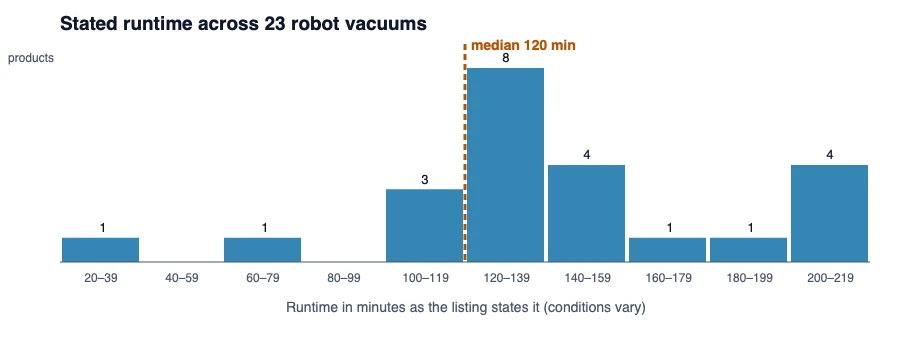
The caution is the same as for any runtime. None of the robot listings we read says which suction mode the figure was measured on, and in the stick class, where several listings do state their conditions, the figure is often for the lowest suction setting or the handheld unit. See the stick vacuum report. Treat a robot’s runtime as a ceiling.
Suction: 8 titles claim it, in pascals, from 4,000 to 20,000
8 of the 27 robots put a suction figure in the title, and each states it in pascals. The median is 10000 Pa and the range is a factor of 5. The other 19 state none in the title. A pascal figure on a robot listing is a claim without a stated method: none of these listings says how it was measured, and a rating that differs five to one between two robots tells you about the marketing as much as the motor.
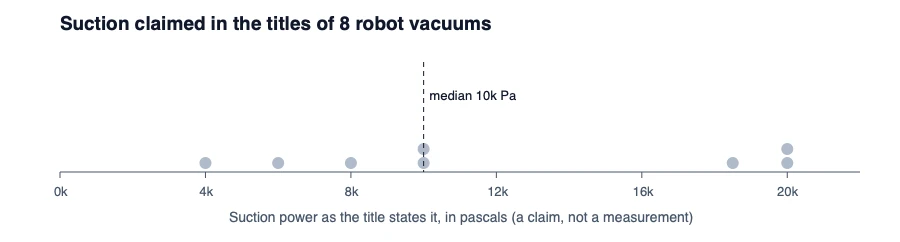
Two robots at the low and high ends make the point: an ILIFE entry model claims 4,000 Pa and two listings claim 20,000, which is five times as much. The eufy X10 Pro Omni and the roborock Q7 M5+ sit in the middle at 8,000 and 10,000 and are a useful pair for seeing how a bullet-point claim and a title claim can differ.
Weight: two groups, and a question the listings do not answer
18 robots state a weight. 8 are listed under four kilograms, 4 between four and six, and 6 at six kilograms or more, up to 12. The median is 4. Those are not three kinds of robot; they are a difference in what the figure includes. A robot on its own weighs a few kilograms, and a self-washing, self-emptying base weighs several more, and the listings rarely say which they are quoting.
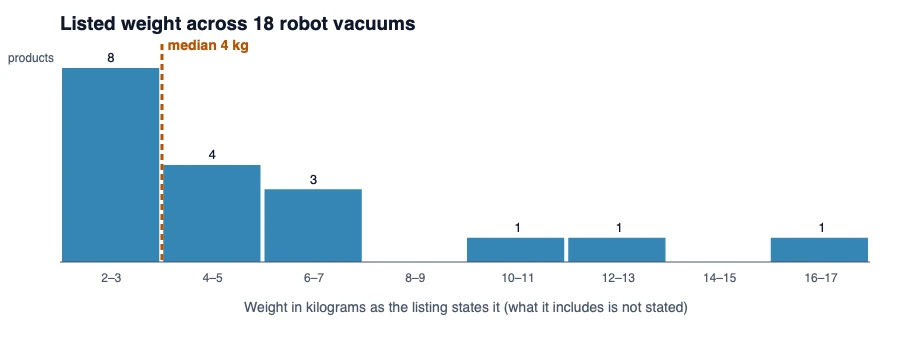
Our own review table and Amazon disagree on the eufy X10 Pro Omni: 8.3 pounds in our review and 26.4 on Amazon, a difference of more than eight kilograms. And the Shark AV2501AE and Roomba 105 Vac page shows two robots whose weights both sources agree on, and that still differ by a factor of 2.5. Agreement between two sources is evidence that both copied the same number, not that the number means what you want.
The dock is now the product
20 of the 27 listings, 74 percent, mention a dock, a station or self-emptying, and 15 are vacuum-and-mop combinations. That changes what a capacity figure means. Of the 14 robots that state a capacity, 7 state 0.7 litres or less, which looks like the robot’s own dust bin, and 6 state two litres or more, which looks like the dust bag in the dock. A median of the two is meaningless, so we do not publish one. When you read a robot’s “capacity” you need to know which bin it describes, and the more useful claim is how many days or weeks the dock runs before it needs emptying, which the two docks on the eufy and roborock page both put at about two months.
Filtration, and noise
Only 3 of the 27 robots state a HEPA filter in Amazon’s filter-type field. Others state “washable”, “cartridge” or nothing, which does not mean they filter badly; it means they do not say. Noise is stated by 12, with a median of 60 dB and a range of 51 to 72. Unlike the stick, upright and handheld classes, where one value, 80 dB, recurs conspicuously, no robot states exactly 80, so the robot figures read as more varied, though we have measured none of them.
What the price band does and does not predict
Of the 22 robots with a price band on record, the band predicts the dock but not the runtime. In the $75–200 band, 4 of 8 mention a dock or self-emptying and 2 are mop combinations; In the $200–500 band, 11 of 11 mention a dock or self-emptying and 6 are mop combinations; In the $500+ band, 2 of 3 mention a dock or self-emptying and 3 are mop combinations. The median runtime is 120 minutes, 120 minutes, 120 minutes across the three bands, in the same order. So what a higher band most reliably buys on paper is a base station, and the listings do not show it buying longer cleaning. Each band holds only a handful of robots, so read this as a tendency in our catalogue, not a rule.
What the listings leave out
Of the 27 robots, 9 state no weight, 4 no plausible runtime and 15 no noise figure. Noise is the gap that matters most: more than half the class gives no number at all, so a comparison on noise can include only a minority of the robots, and we do not rank on it. The robots that do state it are not a random sample: they skew toward the better-documented listings.
Who is in the catalogue
iRobot accounts for 9 of the 27, and 6 of those are Roomba 104 or 105 variants that differ mainly in their dock and whether they mop. That is a fact about what this site reviewed, not about the market, and it weights every median above toward entry-level iRobot models. The price bands tell the same story: 11 sit in the $200–500 band, 8 in $75–200 and 3 in the $500+ band.
How to use this
- If weight matters, ask what it includes. A robot listed at six kilograms or more is almost always quoting a station;
- Treat a pascal figure as marketing. Look instead for a stated test method, a runtime and a dock interval, none of which the listings usually give;
- If you have pets or allergies, note that only 3 of 27 state a HEPA filter, and ask about the others;
- To narrow by your own answers, use the vacuum finder; to read one robot in full, browse the robot vacuum reviews.
Figures are the manufacturers’, as published on each listing and quoted in our reviews; none was measured by us. How we work · Affiliate disclosure