

Stick Vacuums: What 23 Spec Sheets Actually Say
Across 23 stick vacuums, runtime is a ceiling measured in the kindest mode, suction is stated in four units that cannot be compared, and 4 of 14 noise figures are exactly 80 dB. Here is the class in numbers.
What we analysed, and how
This report covers every stick vacuum our site has reviewed and kept: 23 machines from 16 brands, sorted by Amazon’s own category for each product. 2 of them are corded sticks that Amazon files with the cordless ones, so runtime figures are taken only from the 21 battery-powered machines. For each we have two independent transcriptions of the listing, our review’s table and Amazon’s detail page. Our review tables quote weight on most pages but runtime on only a fraction, so most runtime figures here come from one source.
| Stick vacuums | Count | Notes |
|---|---|---|
| Reviewed and kept | 23 | 16 brands; Shark 6 |
| Battery-powered | 21 | 2 corded sticks are filed with them |
| State a plausible runtime | 17 | 1 figure left out as impossible |
| State a weight | 16 | 70 percent |
| State a noise figure | 14 | 4 of them state exactly 80 dB |
| Put a suction figure in the title | 10 | in four different units |
| State a HEPA filter | 14 | 61 percent |
Runtime: a median of 45 minutes, and the conditions behind it
Of the 17 battery-powered sticks that state a plausible runtime, the median is 45 minutes and the middle half runs from 40 to 60. The range is 20 to 70. We left out 1 figure: one listing’s structured field reads 720 minutes, twelve hours, which is not a runtime.
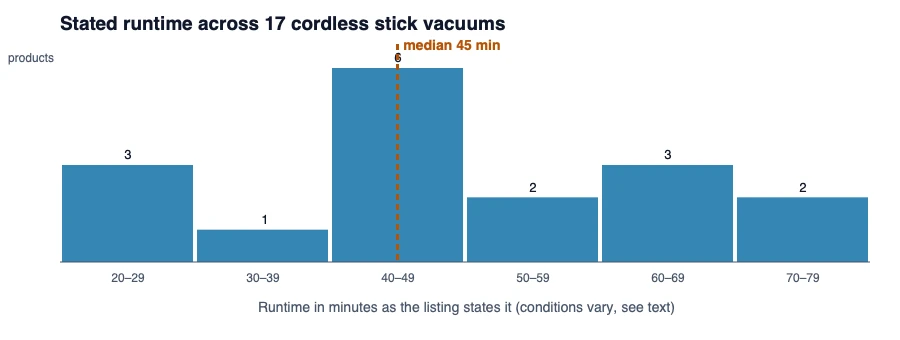
Of the 18 battery-powered sticks that state a runtime, 9 also mention, in their title or bullet points, a low or standard mode, a no-load test or a handheld measurement. The 650W 70-minute listing gives its figure for low suction, no load, 25°C and a new battery. The Shark Pet Cordless footnotes its 40 minutes as measured on the handheld in standard mode. A runtime you can use on a rug with the floor head on is shorter than any of these, and none of the listings states it.
Listings that contradict themselves
2 battery-powered sticks state two different runtimes under Amazon’s “Battery Life” and “Runtime” labels, once the units are reconciled. The CHEBIO gives 20 minutes in one field and 45 in the other. A listing that states two answers to the same question gives no way to know which a seller means, and a buyer comparing runtimes across listings will read whichever field a site happened to display.
Suction: four units, none comparable
| Unit stated in the title | Titles | Example |
|---|---|---|
| Kilopascals (kPa) | 7 | 40 to 55 kPa |
| Pascals (Pa) | 1 | 40,000 Pa |
| Air watts (AW) | 1 | 185 AW |
| Motor watts (W) | 1 | a bare wattage |
| No suction figure | 13 | 57 percent of the class |
Suction is the most advertised number on a stick vacuum and the least comparable. 10 of the 23 titles state one, in four units, and a kilopascal, a pascal, an air watt and a motor wattage measure different things, in different ways, for different parts of the machine. 6 of the titles lead with a motor wattage and a kilopascal figure together. Even where the units match, the claims run from 40 to 55 kPa, which none of the listings explains. Do not choose between sticks on a suction number.
The listings that win every column
The 7 sticks that lead with a kilopascal figure in the title are a distinct group, from 7 different smaller brands, and they state better figures than the other 16 on almost every row. Their median runtime is 60 minutes against 40, their weight 2.3 kilograms against 2.9, their dust bin 1.6 litres against 0.7, their motor power 600 watts against 181, and their stated noise 59 dB against 79. All 7 state a HEPA filter, against 7 of the other 16. Dust bins show it too: 5 of the 7 sticks that state a bin of 1.5 litres or more belong to this group, while the established brands mostly state bins under a litre.
A group that is lighter, longer-running, bigger-binned, three times as powerful and twenty decibels quieter than the established brands, at similar price bands, is either a real engineering advantage or a listing-writing one. The listings do not let us tell which, and we have tested none of them. What the pattern does tell you is that the numbers on these listings are not independent: they move together, which is what you would expect from figures chosen to look good rather than measured. Read them as claims, and compare the named brands on what they state about themselves.
Why 650 watts and 70 minutes cannot describe the same mode
A battery sets a limit that no listing can advertise past. The 650W listing states a 29.6-volt pack built from eight 2,800 mAh cells. If those cells are in series, as the voltage implies, the pack holds about 82.9 watt-hours, which would run a 650-watt motor for about 7.7 minutes. A runtime of 70 minutes from the same pack implies an average draw of about 71 watts, around 11 percent of the headline motor power. So the 650 watts and the 70 minutes are both on the listing and cannot describe the same mode: the wattage is a peak and the runtime is a low-power figure, which is just what the listing’s own “low suction mode” footnote says.
The 80 dB problem
14 sticks state a noise figure, with a median of 75 dB and a range of 58 to 84. 4 of them state exactly 80. Across the uprights and handhelds in our catalogue the same value recurs: 17 of the 47 sticks, uprights and handhelds that state noise state exactly 80 dB. A figure that repeats across unrelated machines of different sizes and prices is closer to a default than a measurement, and no robot in our catalogue states it. We report the figures as stated and do not treat 80 as evidence of anything about one machine.
Weight, wattage and the white-label problem
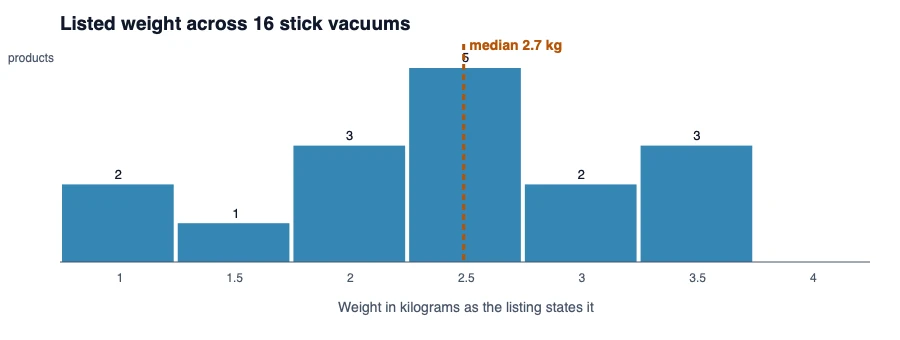
16 sticks state a weight, with a median of 2.7 kilograms and a range of 1.2 to 3.9. Across all vacuum classes, our review tables and Amazon agreed on 70 of the 82 weights that both state, and weight is the figure most often stated by both.
Other fields are less reliable. One listing’s “wattage” reads 2,033 watts, which is the model number in its title, a Bissell 2033, read as a power rating, and we left it out. And the catalogue holds several near-identical listings: three carry near-identical “650W 55KPa 70Mins” titles with different stated weights, and the Shark Pet Cordless appears twice in different colours. A catalogue like ours counts listings, not models, so a class statistic can quietly count one product twice or two products as one.
Who is in the catalogue
Shark accounts for 6 of the 23 and Bissell for 3; the other 14 brands contribute one or two models each. The price bands: 10 in $75–200, 3 in $30–75, 3 in $200–500, and 7 with no band on record.
How to use this
- Read a runtime as a ceiling. Look for the conditions in the bullet points, and be wary of a listing that gives two figures;
- Do not choose on suction numbers. Four units are in use and none is comparable;
- If weight matters, ask what the listing includes. It is the figure our two sources most often agree on, but agreement is not the same as a full account;
- To narrow by your own answers, use the vacuum finder; to read one stick in full, browse the stick and cordless vacuum reviews.
Figures are the manufacturers’, as published on each listing and quoted in our reviews; none was measured by us. How we work · Affiliate disclosure